![rat[LAB] Logo](https://static.wixstatic.com/media/620f22_133c4fae783c4e2dbc4d10827a47885e~mv2.png/v1/crop/x_0,y_413,w_6019,h_1108/fill/w_300,h_50,al_c,q_85,usm_0.66_1.00_0.01,enc_avif,quality_auto/rat%5BLAB%5D%20Logo.png)
When Bollywood Has a FWICE and Architecture Has Nothing: A ₹35 Lakh Fraud, an Industry's Silence, and the Accountability Crisis No One Wants to Talk About
This article is written in continuation of two previously published accounts documenting our professional experience with Ar. Sparshi Gupta of Design Foundation. The facts stated herein are based on written communication, recorded meetings, contractual documents, and statutory records. Legal recovery and regulatory recourse are currently underway. This piece is shared solely for professional awareness and does not constitute a judicial finding.
By now, most of India has heard about Ranveer Singh and Don 3.
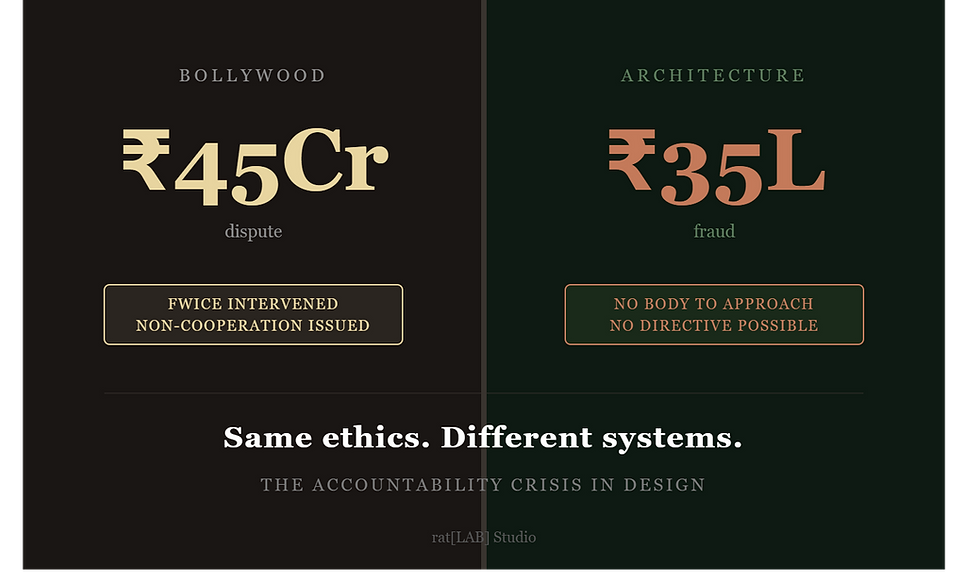
A superstar. A prestigious franchise. A production house that claims ₹45 crore in pre-production losses. And a federation — the Federation of Western India Cine Employees (FWICE) — that, when pushed far enough, issued a formal non-cooperation directive against one of Bollywood's biggest names.
You can agree or disagree with how the Ranveer-Farhan dispute unfolded. Reasonable people can take either side.
But here is the one thing that stood out for us — not as film fans, but as design professionals currently fighting our own battle:
Bollywood has a system. Architecture does not.

The Ranveer Situation: A Familiar Pattern in an Unfamiliar World
For those following the Don 3 controversy, the sequence of events will sound familiar to anyone who has been on the receiving end of a professional betrayal.
A commitment was made. Significant resources were invested. Then, at a critical stage — when walking away caused maximum damage — one party exited. Communication became selective. Accountability became a matter of legal interpretation.
What followed was months of silence, multiple notices ignored, and finally an industry body stepping in to do what contracts and goodwill could not: create consequences.
On May 25, 2026, FWICE issued a formal non-cooperation directive against Ranveer Singh — instructing all union members and affiliated technicians not to work with him until the dispute was addressed. The directive didn't resolve the ₹45 crore claim. It didn't replace a court order. But it did something the legal system cannot do in months, sometimes years: it created immediate professional consequence.
That is the power of an industry accountability system.
We do not have one.
Our ₹35 Lakh Fraud: The Same Pattern, No Federation
We have documented this case in detail across two previous articles — but for those reading this for the first time, here is what happened.
rat[LAB] Design FAB executed an interior project in Gurugram, routed through Ar. Sparshi Gupta of Design Foundation, who acted as the design consultant and sole financial intermediary between us and the end client.
The work was done. The site was completed. Celebratory content was being created and shared. And then — in a pattern that will feel familiar to far too many contractors and execution agencies in this country — the payments stopped.
Approximately ₹35 lakhs remain unpaid, including deliberately withheld GST, which creates statutory liability for us despite the client having received and occupied the space.
What followed was false assurances. Then silence. Then a communication blackout. And then the discovery that Ar. Sparshi Gupta of Design Foundation had moved her office to share workspace with the very end client associated with this project — while multiple vendors connected to the same project reported identical experiences of unpaid dues and unanswered communication.
Seven or more vendors. One project. One architect at the centre of it.
If you would like the full documented account, you can read:
We Looked for a FWICE. We Found Nothing with Teeth.
After this situation unfolded, we did what any responsible professional would do.
We reached out. We spoke to peers. We approached the Council of Architecture. We engaged with designer communities, WhatsApp groups of senior professionals, and industry networks. We hoped someone — some body, some forum, some respected voice — would step in.
And here is the honest truth: people wanted to help, but no one could compel the other party to move.
The Council of Architecture acknowledged the situation. But there were no legal grounds for them to intervene in a commercial dispute between two private parties. Their jurisdiction, understandably, does not extend to forcing payment recovery or mediating financial fraud.
Senior peers — respected designers whose names carry weight in this industry — were sympathetic. But sympathy does not release ₹35 lakhs. Good intentions do not make a party that has gone silent pick up the phone.
WhatsApp groups were gently engaged. Communities were informed. We genuinely hope that with continued awareness, more professionals will come forward — because a studio with over a decade of credibility in this industry should not have to fight this battle alone and in silence.
But the larger reality is this: there is no architecture industry equivalent of FWICE.

The Accountability Vacuum in Our Profession
Bollywood is not a perfect industry. But it has something we do not: an organised body that can create immediate professional consequence when one party damages another.
FWICE represents thousands of technicians and craft workers. When it issues a non-cooperation directive, careers feel it. Projects stop. The industry takes notice. Even a star of Ranveer Singh's stature cannot simply ignore three notices and continue as if nothing happened without consequence.
Now ask yourself: what happens in architecture?
When a design consultant colludes with a client to defraud an execution agency, there is no body that can issue a non-cooperation directive against them. When a firm like Design Foundation leaves seven vendors unpaid and simply relocates its office, there is no federation that calls them in for a hearing. When an architect misuses their position as a payment intermediary to manipulate outcomes, the only recourse is a personal legal battle — expensive, slow, and designed, it seems, for the patient and the deep-pocketed.
The legal system in India is not broken — but it is slow. Cases can drag on for months, sometimes years. And parties that know this use that slowness deliberately. They hide behind legal proceedings as a shield. They make fraud expensive to prove. They wear down smaller firms and individual vendors who simply cannot sustain the financial and emotional cost of a prolonged legal battle.
Design Foundation is doing exactly this.
Named, documented, and on public record across now three articles — the fraud continues to hide behind legal process. Ar. Sparshi Gupta of Design Foundation continues to practice without professional consequence. Seven or more vendors remain unpaid. And the rest of us — the architecture and interior design community — look on, shake our heads, and move to the next project.
What Bollywood Understands That Architecture Does Not
The FWICE directive against Ranveer Singh may or may not be justified in its entirety — that is for the courts and the industry to decide. But what it demonstrates is a principle that our profession has not yet accepted:
Professional accountability cannot wait for the legal system.
When financial fraud, collusion, or professional misconduct happens within a creative industry, the community itself must have a mechanism to respond. Not to replace courts. Not to deliver judgments. But to signal — clearly, collectively, and with consequence — that the community does not protect those who damage it from within.
Bollywood understood this. FWICE exists not because the film industry is perfect, but because it learned — over decades — that without organised collective response, bad actors simply move from project to project, leaving damage behind.
We have the Council of Architecture. We have the Indian Institute of Architects. We have associations, forums, and communities. But none of them, in their current form, have the mandate or the mechanism to do what FWICE did last week.
That needs to change.

A Call to the Profession
rat[LAB] has been a part of this industry for over a decade. We have contributed to education, research, and practice. We have built communities, trained hundreds of students, and worked to raise the standard of design practice in India.
We did not expect to be writing a third article about a fraud. We hoped this would be resolved. We hoped the profession would rally. We hoped that somewhere in the ecosystem of peers, councils, and communities, there would be a mechanism to help.
We are still hoping.
But we are also saying this plainly: if this can happen to rat[LAB], it can happen to any firm in this country. And without an accountability system — without a body that can act swiftly, that has professional teeth, that can make fraud costly in ways that courts alone cannot — it will keep happening.
To our peers who have heard about this situation, engaged with it privately, and expressed support: we are grateful, and we ask you to do more than sympathise. Speak about it. Name it in your professional networks. Refuse to refer or recommend parties who have demonstrated this conduct. Use the only informal power the industry has right now — collective professional opinion — until a formal system exists.
To the Council of Architecture, the IIA, and every design body in this country: this case is a case study for why a professional accountability mechanism is urgently needed. Not just for rat[LAB]. For every contractor, every execution agency, every small studio that completes work in good faith and finds itself chasing payments while the other party hides behind legal process.
And to Ar. Sparshi Gupta and Design Foundation: this is the third public, documented account of this matter. The legal proceedings are ongoing. The professional community is aware. The GST trail is documented. The communication record exists. Continuing to use legal slowness as a shield does not make the facts disappear — it only extends the period before accountability arrives.
The Parallel That Cannot Be Ignored
A ₹45 crore Bollywood dispute reached a federation hearing within months. Industry notices were issued. National media covered it. An entire ecosystem mobilised.
A ₹35 lakh architecture fraud — with seven or more affected vendors, documented collusion, deliberate GST withholding, and a communication blackout — has no federation to approach. No non-cooperation directive to issue. No industry body with the power to make the other party even show up to a conversation.
The numbers are different. The industries are different. But the ethics at the centre of both stories are identical:
When you take someone's work and refuse to pay, you are not making a business decision. You are committing fraud. And the profession — any profession — must have a way to say so.
Moral Note
Fraud, cheating, and collusion may appear calculated — but consequences are never controllable.
Whether one believes in law, karma, or conscience — every action has an echo.
Money withheld is someone else's labour. Someone else's responsibility. Someone else's survival.
Keep your conscience clear. Keep your profession clean. Because no project, no client, no short-term gain is worth destroying trust.
As we often say — quietly but firmly —
God is watching. And so is the profession.
We regret being part of this project. We do not regret sharing this learning.
If this third article pushes even one professional body to consider a formal accountability mechanism, or prevents one more execution agency from being trapped by the same pattern — it has served its purpose.
Related Reading
Disclaimer
This article reflects documented professional experiences and ongoing legal proceedings. It is shared solely for industry awareness and does not constitute a judicial finding. All statements regarding Ar. Sparshi Gupta and Design Foundation are based on written communication, recorded discussions, contractual documentation, and statutory records. All matters are subject to due legal process. The reference to the Ranveer Singh / FWICE matter is cited solely as a public industry parallel for the purpose of professional commentary and carries no personal position on the merits of that dispute.
Comments